Automatic sprinklers are the main protection for most buildings, but some hazards do not suit water, or water alone is not enough: a server room, an electrical panel, a tank of flammable liquid or a fryer in a commercial kitchen. This is where special hazard fire suppression systems come in. Each one is designed for a specific hazard, with an extinguishing agent and a discharge method that match it.
This article compares the common technologies: clean agents, carbon dioxide, water mist, foam, kitchen systems, aerosol and detection tube systems. For each one it covers typical applications, limits and the technical reference standard.
Key takeaways
- No single special hazard technology suits every risk. Selection starts with the nature of the hazard and whether the space is occupied.
- Each technology has its own NFPA standard: NFPA 2001 for clean agents, NFPA 12 for carbon dioxide, NFPA 750 for water mist, NFPA 11 for foam, NFPA 17A for kitchen systems and NFPA 2010 for aerosol.
- Carbon dioxide is lethal at extinguishing concentrations, so it is not used in occupied spaces without strict safeguards.
- Water mist and aerosol systems are designed to the product listing and the manufacturer’s manual for the specific application, not to generic tables.
- The legal requirement in Egypt is the Egyptian Code for the Design and Implementation of Fire Protection for Buildings (2026 edition) and approval by the General Directorate of Civil Protection.
In this article
- When does a project need a special hazard suppression system?
- Special hazard suppression systems compared
- Clean agents: HFC-227ea, FK-5-1-12 and inert gases
- Carbon dioxide: effective but dangerous to people
- Water mist
- Foam for flammable liquids
- Commercial kitchen suppression systems
- Aerosol and detection tube systems
- How to choose between special hazard suppression systems
- Common mistakes
- Special fire suppression solutions from AZEIDK Egypt
- Frequently asked questions
- Conclusion
When does a project need a special hazard suppression system?
Special hazard suppression (often called “automatic suppression” in the Egyptian market) is used when water would damage the contents, such as electronic equipment and archives; when water is not effective, as with flammable liquid and cooking oil fires; or when the hazard needs fast local suppression inside an enclosed space, such as an electrical panel.
The binding reference in Egypt is the Egyptian Code for the Design and Implementation of Fire Protection for Buildings — 2026 edition (Minister of Housing Decree No. 355 of 2026), together with approval of the project drawings by the General Directorate of Civil Protection (Ministry of Interior). NFPA and EN standards, UL listings and FM approvals are technical references for design and equipment selection. The manufacturer’s instructions and the design manual for each system set the details needed to stay within its listing.
Special hazard suppression systems compared
| Technology | How it extinguishes | Typical applications | Main limitations | Technical reference |
|---|---|---|---|---|
| Halocarbon clean agent (HFC-227ea, FK-5-1-12) | Absorbs heat and interrupts the combustion reaction | Server, telecom and control rooms, archives | Needs a tight room; environmental restrictions on HFCs | NFPA 2001 |
| Inert gas (IG-541, IG-55, IG-01) | Lowers the oxygen level | Data rooms and sensitive equipment | More cylinders, more storage space and pressure venting | NFPA 2001 |
| Carbon dioxide (CO2) | Lowers oxygen and cools | Transformers, generators, rotating equipment and unoccupied spaces | Lethal at extinguishing concentrations | NFPA 12 |
| Water mist | Cooling, oxygen displacement by steam and blocking of radiant heat | Machinery and turbine spaces, some buildings and sites that need low water use | Follows the system listing and the manufacturer’s manual for the specific application | NFPA 750 |
| Foam | Blankets the liquid surface, separates it from oxygen and cools it | Fuel tanks, loading stations, hangars and flammable liquid stores | Concentrate and proportioning rate chosen per liquid; shift away from PFAS-containing foam | NFPA 11 |
| Kitchen wet chemical agent | Saponifies and cools the oil | Cooking appliances and exhaust hoods and ducts | Kitchens only; gas shut-off required | NFPA 17A, UL 300, EN 17446 |
| Condensed aerosol | Fine particles interrupt the combustion reaction | Enclosed spaces, mostly unoccupied | Some types for unoccupied spaces only; particle residue | NFPA 2010 |
| Detection tube systems | Linear heat detection that releases the agent locally | Electrical panels, cabinets and machines | Cover only a small, defined space | Manufacturer listing and design manual |
The table is for initial comparison only. The final decision is based on the hazard study, the Egyptian code and the design manual of the selected system.
Clean agents: HFC-227ea, FK-5-1-12 and inert gases
A clean agent leaves no residue and does not conduct electricity, so it is the preferred choice for protecting sensitive equipment by total flooding. There are two families: halocarbon agents such as HFC-227ea (known by the trade name FM-200) and FK-5-1-12, and inert gases such as IG-541, IG-55 and IG-01. The U.S. Environmental Protection Agency (EPA) lists these agents as acceptable for total flooding, provided they are used in line with the latest edition of NFPA 2001. For IG-541, it also requires that the carbon dioxide produced at the design concentration does not exceed 5%.
A total flooding system works only if the room is tight enough to hold the concentration for long enough, and if a control panel manages release, delay and abort. For more on these details, see our article on clean agent fire suppression systems.
Carbon dioxide: effective but dangerous to people
The carbon dioxide system (CO2 system) is one of the oldest and most effective suppression systems for electrical and rotating equipment and unoccupied spaces. NFPA 12 (2025 edition) covers it for total flooding and local application. However, the EPA report on the risks of carbon dioxide shows that the minimum design concentration for extinguishment starts at 34% and reaches 75% depending on the fuel, and that the gas is lethal at these concentrations: exposure above 17% leads to loss of consciousness and death within one minute. The report recorded 119 deaths in 62 documented incidents.
CO2 systems therefore include essential safeguards: a supervised lockout valve that prevents discharge while untrained people are present or during maintenance, a pre-discharge alarm, a time delay, clear warning signs, and evacuation of the space before any testing or maintenance. In normally occupied rooms, such as control rooms, an alternative such as a clean agent is usually the better choice.
Water mist
A water mist system uses very fine droplets, typically between about 10 and 1,000 microns in diameter, according to an article by an NFPA engineer. Fine droplets increase the water surface area exposed to heat. They cool the flame, turn to steam that displaces oxygen near the fire, and block part of the radiant heat. NFPA 750 classifies systems by operating pressure: low (below 175 psi), intermediate (175 to 500 psi) and high (above 500 psi). The latest edition of the standard is the 2027 edition.
The key point is that a water mist system is not designed from generic tables like sprinklers. It follows the manufacturer’s design manual and the system listing for the specific application, and its design cannot be transferred to a hazard it was not listed for. Its nozzles are tested to standards such as UL 2167. A common practice is to use stainless steel piping so that rust does not block the nozzles. For more details, see our article on water mist systems.
Foam for flammable liquids
In flammable liquid fires, water can spread the burning fuel instead of putting it out. Foam is used instead: it blankets the liquid surface, separates it from oxygen and cools it. Types include aqueous film-forming foam (AFFF), alcohol-resistant foam (AR-AFFF) for polar solvents, and fluorine-free foam. NFPA 11 (2024 edition) covers low-, medium- and high-expansion foam systems.
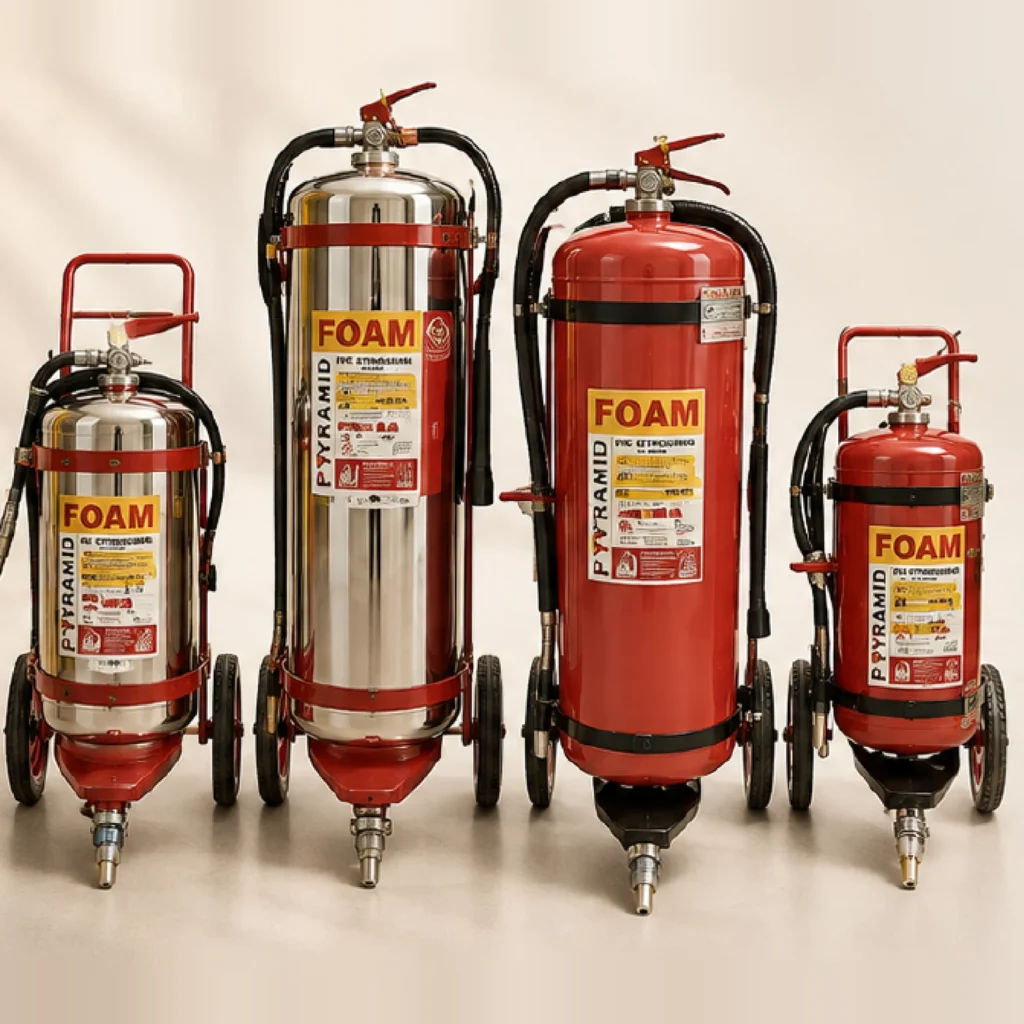
Worldwide, the industry is moving away from foam containing PFAS compounds. On 3 October 2025, the European Commission adopted a restriction on their use in firefighting foam, with transition periods of 12 months to 10 years depending on the use. Whenever a concentrate is replaced, its compatibility with the proportioning equipment and discharge devices must be checked. AZEIDK Egypt solutions include foam systems to suit the application, and PYRAMID AFFF foam extinguishers in 6 and 9 litre portable and 25 and 45 litre wheeled sizes. For details on foam systems, see our article on foam fire suppression systems.
Commercial kitchen suppression systems
Cooking oil fires need a wet chemical agent that reacts with the hot oil to form a layer that cuts off oxygen and cools the surface, while gas to the appliances is shut off the moment the system operates. Design refers to NFPA 17A (2024 edition), and the systems are tested to UL 300 or EN 17446.
AZEIDK Egypt supplies HoodSafer systems, designed and manufactured in Turkey: the fully mechanical HS series and the HSP series with pneumatic detection. They operate automatically on heat or manually, with a gas shut-off valve. They conform to EN 17446:2021, hold BSI Kitemark KM 767382 and are approved by the General Directorate of Civil Protection. For details, see our guide to commercial kitchen fire suppression systems.
Aerosol and detection tube systems
Condensed aerosol
When activated, an aerosol generator produces very fine particles that interrupt the combustion reaction, and it needs no pressurised cylinders. It is covered by NFPA 2010 (2025 edition), and the units are tested to UL 2775. Aerosol types differ in their conditions of use: according to the EPA list, several of them are limited to normally unoccupied spaces. Check the listing and conditions of the specific product before selecting it.
Detection tube systems (Fire Search)
These systems use a flexible pressurised tube routed inside the panel or cabinet above the sources of risk. In a fire, the tube bursts at the hottest point, the pressure drops and the agent is released directly into the protected space. Their advantage is that they detect and suppress the fire inside the small enclosure before it spreads to the room. AZEIDK Egypt supplies Fire Search systems for panels and cabinets as part of its special fire suppression solutions, as well as PYRAMID automatic Fire Search extinguishers: dry powder in 6 and 12 kg and carbon dioxide in 3, 6 and 10 kg, operated by a linear detection tube.
How to choose between special hazard suppression systems
- Type of hazard: electrical equipment, flammable liquids, cooking oils or solid materials.
- Occupancy: are people normally present in the space? This rules out CO2 and some aerosol types, or calls for additional safeguards.
- Enclosure integrity: total flooding needs a room that can be sealed.
- Effect of the agent: can the contents tolerate water or residue? How long will it take to get back into operation?
- Listing and approval: is the system listed for this hazard in this configuration? Check the datasheet and the design manual.
- Maintenance and recharging: local availability of the gas or agent, spare parts and refill service.
Common mistakes
- Choosing the system on price or habit before studying the hazard and occupancy.
- Installing a total flooding system in a room with unsealed openings and penetrations.
- Using CO2 in an occupied space without a maintenance lockout valve and a pre-discharge alarm.
- Transferring a water mist or aerosol design from one hazard to another it was not tested for.
- Replacing a foam concentrate with another type without checking its compatibility with the proportioning equipment.
- Overlooking gas and power shut-off in kitchen systems.
- Not connecting the suppression control panel to the building fire alarm panel and HVAC shutdown.
Special fire suppression solutions from AZEIDK Egypt
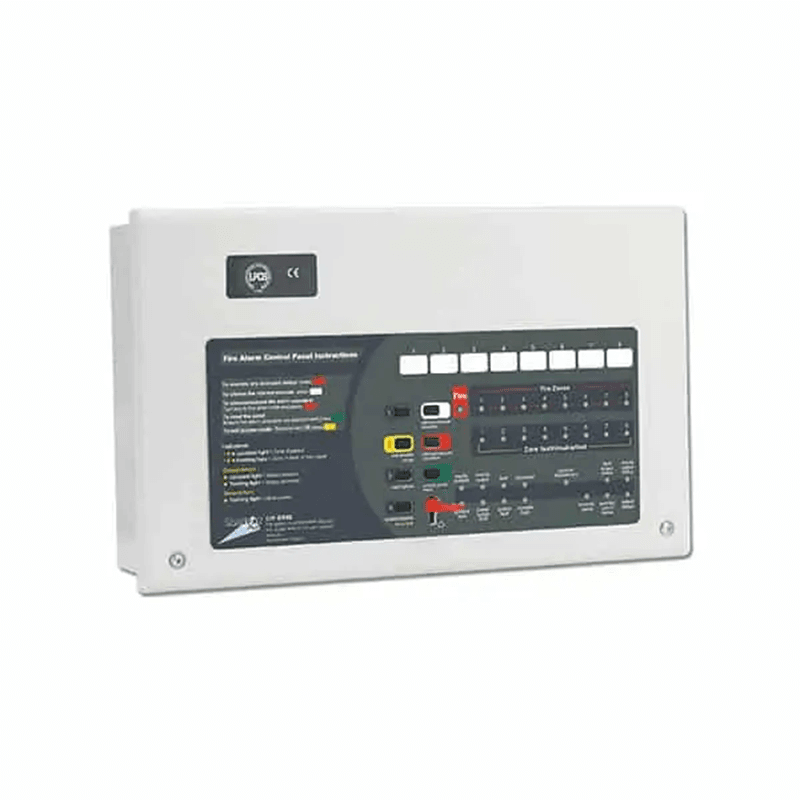
AZEIDK Egypt’s special suppression solutions include: total flooding systems for transformer rooms and electrical rooms; AFC-227 / P227 clean agent systems from American Fire Control, which use HFC-227ea according to the datasheet; Fire Search systems for panels and cabinets; and suppression control panels with activation and abort points. These come with a hazard study and quantity calculations based on the protected area. Applications include power stations and transformer rooms, factories and control rooms, hospitals and server rooms, and archives. AZEIDK Egypt’s current product list does not include water mist systems.
Frequently asked questions
What is the difference between FM-200 and a clean agent?
FM-200 is a trade name for HFC-227ea, one of the halocarbon clean agents. Clean agent is a wider category that also includes FK-5-1-12 and the inert gases.
Can a CO2 system be used in a server room where staff work?
It is not recommended. Carbon dioxide is lethal at extinguishing concentrations, so a clean agent is preferred in occupied spaces, and CO2 is generally limited to unoccupied spaces with strict safeguards.
Can a water mist system replace sprinklers?
Only in some cases, and only if the system is listed and tested for that same hazard and the authority having jurisdiction accepts it. Its design must not be extended to hazards it was not tested for.
Which system suits an electrical panel?
Panels are often protected with detection tube systems that detect and suppress the fire inside the panel itself. The whole room may also be protected with a total flooding system, depending on the hazard study.
Is NFPA 2001 mandatory in Egypt?
Not in itself. The binding requirements are the Egyptian code and civil protection approval. NFPA 2001 and other standards are used as technical references for design, or where the contract documents call for them.
Conclusion
Special hazard suppression systems are not interchangeable options to be chosen on price. Each technology has a hazard it suits and limits that must be respected: clean agents for sensitive equipment in tight rooms, CO2 for unoccupied spaces, foam for flammable liquids, wet chemical for kitchens, and detection tubes for panels. The right decision starts with a hazard study and ends with a system that is listed for that hazard and approved by Civil Protection.
Do you have a server room, electrical panels or a commercial kitchen that needs special protection? Send us the dimensions of the space and the nature of the hazard, and we will propose a suitable system with its datasheet and a quantity study. Talk to the AZEIDK Egypt team