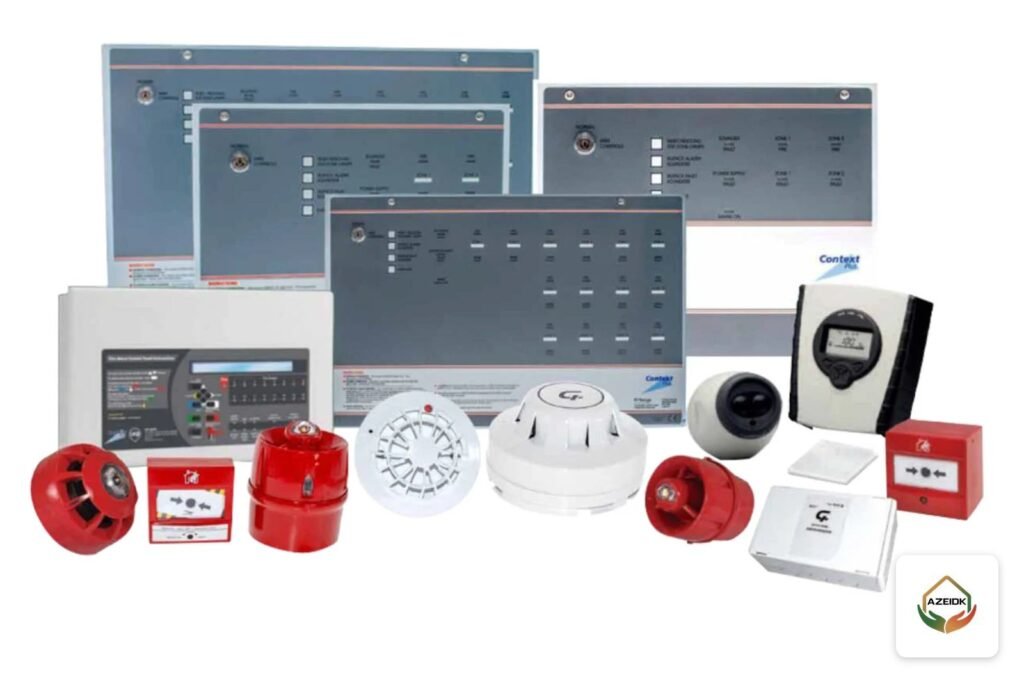
When an owner in Egypt asks for a “fire alarm device“, they rarely mean one item. They mean a chain: a detector that senses smoke or heat, a panel that decides, and a siren everyone can hear. Knowing that chain before you buy avoids quotes that cannot be compared and devices that do not work together.
This guide covers standalone alarms versus systems, the components from panel to siren, siren selection, conventional versus addressable, and what to ask your supplier.
Key takeaways
- A standalone smoke alarm combines the sensor, control and sounder in one unit. Its European standard, EN 14604, covers household use, and it is not meant to be part of a system with a control panel.
- A system smoke detector only detects and sends a signal to the panel. The panel then drives the sirens.
- Each system component has its own part in the EN 54 series: panel EN 54-2, sounder EN 54-3, power supply EN 54-4, smoke detector EN 54-7, manual call point EN 54-11, visual alarm device EN 54-23.
- Choose the siren by location: indoor or weatherproof outdoor, sound only or sound plus strobe, and loud enough to rise above the background noise.
- The choice between conventional and addressable depends on building size, number of zones and how precisely you need to locate an alarm.
In this article
- What do you mean by a fire alarm device: a standalone unit or a system?
- System components from the panel to the siren
- The right detector for each space
- Fire alarm sirens: bells, sounders and beacons
- Conventional or addressable: how to decide as a buyer
- What to ask your supplier before you buy
- Common mistakes when buying a fire alarm device
- Frequently asked questions
- Conclusion
What do you mean by a fire alarm device: a standalone unit or a system?
The same words describe two different things. The first is a standalone smoke alarm on the ceiling, battery or mains powered, with a built-in sounder. NFPA 72 defines a smoke alarm as a single- or multiple-station alarm that responds to smoke, with the sensor, control components and notification appliance in one assembly. Its European standard, EN 14604, covers household and similar residential use and excludes devices meant for systems with separate control and indicating equipment.
The second is a system smoke or heat detector. It has no siren and makes no decision; it sends its signal to the panel, which sounds the alarm across the building, logs the event and supervises cables and devices for faults.
A standalone alarm warns only the people near it, and nobody knows it has failed until it is tested. Shops, clinics, offices, factories and the common areas of residential buildings need a complete system approved by Civil Protection as part of the project drawings. What AZEIDK Egypt offers here are the components of fire detection and alarm systems (panels, detectors, sirens and call points). For a villa, a small conventional panel is usually the closest fit.
System components from the panel to the siren
Every system has four groups of parts: detectors and call points, a control and indicating panel, sirens and strobes, and a power supply with standby batteries. Larger buildings add input/output modules and, on addressable loops, short-circuit isolators. The table gives each component’s EN 54 part, which is what you look for on the datasheet.
| Component | Function | EN 54 part | What to check when buying |
|---|---|---|---|
| Control and indicating panel | Receives signals, sounds the alarm, shows faults | EN 54-2 | Number of zones or loops, loop capacity, available outputs |
| Power supply and batteries | Keeps the system running during a power cut | EN 54-4 | Battery capacity calculated for standby and alarm time |
| Point smoke detector | Detects smoke in rooms and corridors | EN 54-7 | Sensing technology (optical) and compatibility with the panel |
| Point heat detector | Kitchens, boiler rooms, dusty areas | EN 54-5 | Operating temperature and type (fixed or rate-of-rise) |
| Beam detector | Halls and high-bay warehouses | EN 54-12 | Path length and mounting height |
| Manual call point (MCP) | Manual alarm activation at exits | EN 54-11 | Indoor or outdoor, resettable or glass |
| Sounder | Audible warning | EN 54-3 | Sound output, IP rating, current draw |
| Beacon / visual alarm device (VAD) | Visual warning | EN 54-23 | Mounting category (ceiling or wall) and coverage |
| Short-circuit isolator | Isolates the section of a loop with a short circuit | EN 54-17 | Built into the device or a separate module |
| Input/output modules | Interface with lifts, HVAC and sprinklers | EN 54-18 | Signal type (dry contact or voltage) |
EN 54-13 covers the compatibility of system components: a good detector is not enough unless it is approved to work with that panel. To see how to build a complete system from one brand, read our Context Plus guide for Egypt.
The right detector for each space
The wrong detector is the biggest cause of false alarms. As a rule: optical smoke detectors for rooms, offices and corridors; heat detectors for kitchens, boiler rooms and steamy or dusty areas; beam detectors for high halls and warehouses.
AZEIDK Egypt offers Context Plus Series 65A conventional smoke and heat detectors, the Context Plus 55000-268 reflective beam detector, and the TANDA TX7130 beam detector for longer distances. Our article on choosing smoke and heat detectors covers the trade-offs in detail.
Fire alarm sirens: bells, sounders and beacons
Owners often ask for the siren on its own, but the panel powers and triggers it. In a conventional system, sounders usually sit on separate notification circuits; in an addressable system they can sit on the loop and draw current from it, which affects the battery calculation and loop length.
Types of notification devices
- Fire bell: the traditional metal bell, still specified on some projects.
- Electronic sounder: selectable tones, wall mounted or built into the detector base (base sounder).
- Sounder beacon: sound and light in one unit for noisy areas or people with hearing impairment.
- Outdoor models: weatherproof units for roofs, factory entrances and car parks. Check the IP rating on the datasheet and name the outdoor model in the device list.
How loud should the siren be?
There is no single figure. NFPA 72 (2016 edition, section 18.4.3.1, as quoted by Consulting-Specifying Engineer) requires public-mode audible alarms to be 15 dB above the average ambient level, or 5 dB above the maximum level lasting at least 60 seconds, whichever is greater. A noisy hall needs louder or more sirens than a quiet office. This is a design reference; the project documents and the Egyptian code govern.
For the specifications of Context Plus addressable sounders at 91, 96 and 103 dB and their loop current, see our article on Context Plus addressable sounders and beacons.
Conventional or addressable: how to decide as a buyer
A conventional panel knows only the zone in alarm; an addressable panel knows the exact device. The technical detail is in our article on conventional and addressable fire alarm systems. The owner’s questions:
| Owner’s question | Leans conventional | Leans addressable |
|---|---|---|
| Building size | Shop, clinic, office or villa | Mall, hospital, tower or large factory |
| Number of devices | Few, covered by a small number of zones | Many, spread over many floors and areas |
| Locating the alarm | Knowing the zone is enough | The room or device must be identified |
| Interfaces with other systems | Limited | Lifts, HVAC, doors and sprinklers |
| Future expansion | Not expected | More floors or areas expected |
AZEIDK Egypt offers Context Plus ZFP addressable panels and CFP and FP conventional panels, so either type can be built from one brand.
What to ask your supplier before you buy
The binding reference in Egypt is the Egyptian Code for the Design and Implementation of Fire Protection for Buildings, 2026 edition (Ministerial Decree No. 355 of 2026); its third part covers electrical requirements and detection and alarm. The General Directorate of Civil Protection (Ministry of Interior) reviews drawings and inspects before occupancy. EN 54 and NFPA 72 are technical references. Before accepting a quote, ask for:
- Every device by model number, not “smoke detector”.
- Each model’s datasheet and its own approval (EN 54 part or UL listing).
- Confirmation that detectors, sirens and modules are compatible with the panel.
- Zones or loops used and spare capacity.
- A battery calculation for standby and alarm time.
- A clear scope: supply only, or supply, installation, testing and handover.
These points put quotes on the same basis before you look at the total price.
Common mistakes when buying a fire alarm device
- Household smoke alarms in a shop or office that needs an approved system.
- Buying a siren or detector without checking compatibility with the panel.
- Indoor sounders in spots exposed to rain or dust.
- One loud siren for many rooms, so sound does not reach behind closed doors.
- No strobes in noisy production halls and large kitchens.
- Comparing quotes by total price only, not by models, approvals and scope.
- A panel sized for today’s devices with no spare capacity.
Frequently asked questions
Is a standalone smoke alarm enough for my shop?
A standalone alarm is a residential device under EN 14604; it sends no signal to a panel and does not supervise its faults. Commercial premises need an alarm system designed to the Egyptian code and approved by Civil Protection.
Can I buy a fire alarm siren and add it to an existing panel?
Yes, if compatible: in a conventional system its voltage and current must suit the panel’s notification circuit; in an addressable system it must use the panel’s protocol. Check both datasheets.
What is the difference between a sounder and a beacon?
A sounder is an audible warning covered by EN 54-3; a beacon is a visual warning covered by EN 54-23. Beacons are used with sounders in noisy areas or where people with hearing impairment may be present, and some models combine both in one unit.
When should I choose addressable over conventional?
When the building is large or multi-storey, you need the exact device in alarm, the alarm must interface with lifts, HVAC and sprinklers, or you expect to expand.
Must all system devices come from one manufacturer?
Not always, but compatibility is a must (EN 54-13). In addressable systems that usually means the panel manufacturer’s protocol, and one manufacturer also eases approval and maintenance.
Conclusion
Start with one question: a standalone household unit or a complete system? For most premises it is a system: the right detectors, call points at exits, a panel with spare capacity, and sirens and strobes that reach every room. Choose the type by building size and the detail you need, and ask for the model, datasheet and approval of every device. For the panels, detectors and sounders AZEIDK Egypt offers from this brand, see the Context Plus brand page.
Not sure exactly what your building needs? Send us the type of use, floor area and number of floors, or the drawings if you have them, and we will propose the system type and device list with the datasheet for each model. Talk to the AZEIDK Egypt team