FirePro Condensed Aerosol Fire Suppression System
FirePro fixed condensed-aerosol fire suppression system with multiple generator capacities, electrical or thermal activation options and integration with fire-detection and extinguishing-control systems for Class A, B and C hazards.
العلامة التجارية
تفاصيل المنتج
نظرة عامة على المنتج
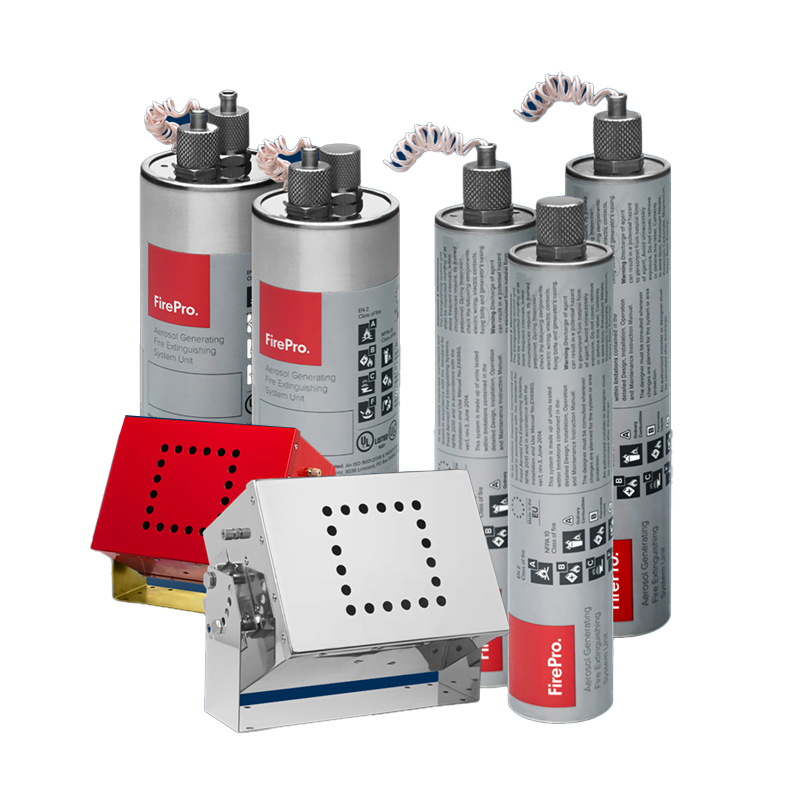
The FirePro condensed aerosol fire suppression system is a fixed extinguishing solution designed to rapidly control fires inside protected enclosures, equipment and technical spaces.
The system uses compact generators that discharge fine condensed-aerosol particles throughout the protected enclosure. These particles interrupt the chemical chain reaction that sustains combustion, helping suppress the fire without the use of water.
In many applications, FirePro generators can be installed directly inside the protected space, reducing the need for large gas-storage cylinders, extensive distribution piping and multiple discharge nozzles.
This page presents the FirePro fixed aerosol-generator family as one complete system category rather than one individual model. The final generator models, quantities and locations must be determined through approved engineering calculations.
Operating Principle:
Each FirePro generator contains a solid fire-extinguishing compound inside a metal housing.
When the generator receives an electrical or thermal activation signal, the compound produces condensed aerosol and discharges it into the protected enclosure.
The aerosol spreads through the space and primarily suppresses combustion by interrupting the chemical reaction within the flame.
System performance depends on:
• Correct extinguishing-compound mass.
• Generator distribution.
• Net enclosure volume.
• Hazard and fuel type.
• Enclosure integrity.
• Installation height and orientation.
• Detection and activation method.
• Required concentration-holding period.
Available Generator Family:
The FirePro catalogue includes a broad range of fixed aerosol generators, including:
• FP-20.
• FP-40.
• FP-80.
• FP-100.
• FP-200.
• FP-500.
• FP-1200.
• FP-2000.
• FP-3000.
• FP-4200.
• FP-5700.
Selected models may also be available in different configurations, including:
• Multiple discharge outlets.
• Single discharge outlet.
• Stainless-steel enclosure.
• Coated carbon-steel enclosure.
• Electrical activation.
• Thermal activation.
• Combined configuration according to the selected model.
Generator selection must be based on approved calculations, required aerosol-compound mass, hazard type and enclosure design.
Activation Methods:
Electrical Activation:
Generators may be activated by an electrical signal from:
• An extinguishing control panel.
• A dedicated controller.
• A fire-detection system.
• A sequential activator.
• An approved manual-release circuit.
Electrical activation is commonly used in automatic systems that require detection, staged alarm and a programmed release delay.
Thermal Activation:
Selected models can be supplied with thermal activation.
The generator activates when the thermal device reaches its specified operating temperature.
Thermal activation may be used in selected standalone applications or as part of an approved protection strategy.
Manual Activation:
Manual-release devices may be provided through the extinguishing control system.
Manual-release controls must be protected from accidental operation and installed in a clear and accessible location for authorized personnel.
Fire Classes:
The catalogue identifies selected FirePro generators for:
• Class A fires involving solid combustible materials.
• Class B fires involving flammable liquids.
• Class C fires according to the applied classification and intended hazard.
Suitability for the specific protected material and hazard must be confirmed during system design.
Main System Components:
A FirePro system may include:
• Condensed-aerosol generators.
• Mounting brackets.
• Extinguishing control panel.
• Smoke or heat detectors.
• Manual call points.
• Manual-release device.
• Audible and visual warning devices.
• Sequential activators.
• Fire-resistant cables.
• Fault-monitoring modules.
• Hold or abort controls.
• System-warning labels.
• Equipment and ventilation shutdown interfaces.
• Connections to the fire-alarm or building-management system.
Control and Detection:
The generators may be integrated with an extinguishing control panel that manages:
• Detection zones.
• First-stage alarm.
• Second-stage alarm.
• Pre-discharge delay.
• Automatic or manual operation.
• Hold and abort functions.
• Activation-circuit supervision.
• Audible and visual warning.
• Ventilation and equipment shutdown.
• Fire-alarm and BMS signaling.
Where multiple generators are installed, sequential activators may be used to control the firing order and timing.
Key Benefits:
• Compact fixed fire-suppression solution.
• Waterless extinguishing technology.
• No large gas-storage cylinders in many applications.
• Reduced distribution-piping requirements.
• Suitable for small and medium enclosures and equipment.
• Broad range of generator capacities.
• Electrical and thermal activation options.
• Rapid extinguishing-agent discharge.
• Local installation inside the protected enclosure.
• Helps avoid water damage.
• No liquid flooding after activation.
• Flexible generator distribution.
• Integration with detection and alarm systems.
• Certified product life of up to 15 years under FirePro conditions.
• Zero ozone-depletion potential according to manufacturer information.
• Suitable for a broad range of industrial and technical applications.
Applications:
• Electrical panels.
• Control rooms.
• Telecommunication rooms.
• Small server rooms.
• Equipment cabinets.
• Distribution boards.
• Generator enclosures.
• Transformer applications subject to approved design.
• Industrial machinery.
• Production equipment.
• Engine compartments.
• Vehicles and heavy equipment.
• Technical containers.
• Energy-storage applications subject to hazard assessment.
• Small enclosed storage spaces.
• Archive rooms.
• Marine applications.
• Transport applications.
• Locations where conventional piping is difficult.
Electrical and Electronic Equipment:
The system is suitable for many electrical and electronic applications because it does not use water.
Before approval, confirm:
• Compatibility with protected equipment.
• Possible fine-particle residue.
• Post-discharge cleaning requirements.
• Electrical shutdown requirements.
• Equipment-manufacturer recommendations.
• Required business-continuity and reliability level.
Engineering Design:
The system must be designed by qualified specialists using manufacturer data and approved calculation methods.
Design activities include:
• Measuring enclosure dimensions.
• Calculating net volume.
• Identifying openings and leakage.
• Identifying protected materials and hazards.
• Confirming operating temperature.
• Selecting the required design density.
• Calculating extinguishing-compound mass.
• Selecting suitable generator models.
• Determining generator quantities.
• Defining installation location and discharge direction.
• Checking for discharge obstructions.
• Selecting the activation method.
• Designing detection and warning circuits.
• Selecting the pre-discharge delay.
• Coordinating equipment and ventilation shutdown.
• Reviewing occupant safety.
• Obtaining consultant and authority approval.
Generator Distribution:
Generators must be distributed to achieve suitable aerosol coverage.
Design considerations include:
• Model-specific discharge distance.
• Avoiding discharge directly toward personnel.
• Preventing equipment from blocking aerosol flow.
• Keeping heat-sensitive materials away from the outlet.
• Maintaining manufacturer safety clearances.
• Allowing access for inspection.
• Using original mounting brackets.
• Protecting cables and connections.
Operating Temperature:
The catalogue shows a wide operating range for selected fixed generators, including:
• -54°C to +54°C.
Actual limits may vary by generator and activation device and must be verified from the selected model data.
Discharge Time:
Discharge duration varies by generator size.
The catalogue shows typical values such as:
• Approximately 5 to 10 seconds for several small and medium generators.
• Approximately 10 to 15 seconds for selected larger generators.
Final discharge duration must be confirmed from the selected model data.
Heat and Safety Clearance:
The aerosol exits the generator at an elevated temperature close to the discharge outlet.
The installation must maintain the required safety distance.
Do not:
• Touch the generator during or immediately after operation.
• Install combustible materials directly in front of the outlet.
• Direct the outlet toward personnel.
• Ignore the specified discharge clearance.
• Cover the discharge openings.
• Modify the generator housing.
Occupied-Space Safety:
Use in occupied areas requires a dedicated safety review covering:
• Design density.
• Enclosure volume.
• Discharge-product concentration.
• Evacuation time.
• Pre-discharge alarms.
• Release delay.
• Hold or abort controls.
• Emergency procedures.
• Authority requirements.
• Manufacturer safety information.
The system must not be assumed suitable for every occupied enclosure without an approved design and safety assessment.
Approvals:
The FirePro catalogue presents certifications and listings that include:
• UL.
• BSI.
• KIWA.
• Other certifications depending on model and market.
Certifications vary by generator model and version. The supplied model must be matched to the project’s approval requirements.
Installation:
• Secure generators with approved brackets.
• Follow the required discharge orientation.
• Maintain specified safety clearances.
• Complete wiring according to manufacturer diagrams.
• Use appropriate approved cables.
• Protect activation circuits from open and short circuits.
• Do not test a generator using a real firing signal.
• Use the manufacturer’s recommended test procedures.
• Label generators and circuits.
• Install clear warning signs.
• Test control and alarm functions without discharging the generators.
• Record installation and test results.
Testing and Commissioning:
Before handover, complete:
• Visual inspection of all generators.
• Model and quantity verification.
• Mounting-bracket inspection.
• Activation-circuit testing according to manufacturer instructions.
• Detector testing.
• First- and second-stage alarm testing.
• Release-delay testing.
• Safe manual-release testing.
• Hold and abort testing where provided.
• Ventilation and equipment-shutdown testing.
• Fault-signal testing.
• Control-panel programming review.
• Calculation and drawing handover.
• Operator and maintenance training.
Maintenance:
• Visually inspect generators.
• Check for damage and corrosion.
• Inspect brackets and fasteners.
• Inspect cables and terminations.
• Test the control panel.
• Test detection and warning devices.
• Test manual-release controls.
• Review manufacturing date and service life.
• Confirm that the enclosure use has not changed.
• Recalculate the system after room or equipment modifications.
• Keep discharge outlets unobstructed.
• Record all inspections and maintenance.
After Discharge:
Following system operation:
• Evacuate the area and restrict entry until authorized.
• Ventilate according to the emergency plan.
• Confirm fire extinction and prevent re-ignition.
• Isolate discharged generators.
• Clean deposits according to manufacturer instructions.
• Inspect protected equipment.
• Replace activated units.
• Inspect and reset the control system.
• Investigate the fire cause.
• Recommission the system before returning it to service.
Required Procurement Information:
• Protected-enclosure dimensions.
• Net volume.
• Hazard type.
• Protected materials and equipment.
• Site operating temperature.
• Floor and ceiling voids.
• Openings and enclosure integrity.
• Required activation method.
• Selected control panel.
• Warning and delay requirements.
• Evacuation requirements.
• Required approvals.
• Consultant and authority requirements.
• Layout drawings.
• Final calculated generator schedule.
Important Note:
A FirePro system must not be selected by general generator quantity or model without an approved calculation.
The generator models, quantities, installation positions and activation method must be engineered by qualified specialists according to the manufacturer’s catalogue, project requirements and authority approval.
The models listed on this page represent the FirePro product family. Extinguishing-compound mass, discharge time, discharge distance, construction and activation method vary by model.
الوثائق الفنية
كتالوج المنتج
اطّلع على البيانات والمعلومات الفنية الكاملة للمنتج من خلال الكتالوج الرسمي.
Related Products
Explore More Products in the Same Category
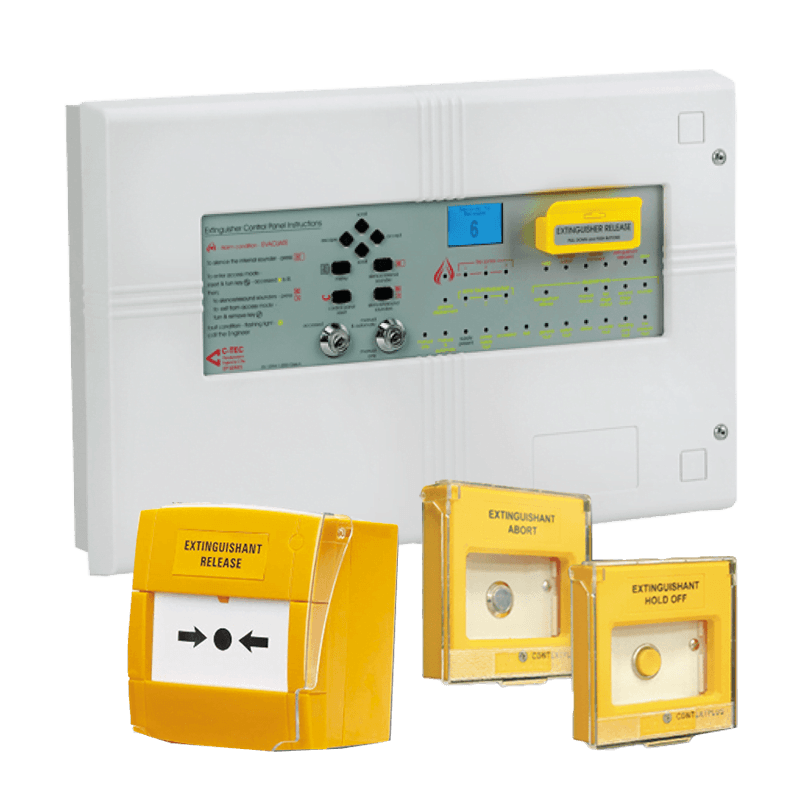
Gas fire suppression systems
Context Plus EP203/CON Automatic Extinguisher Control Panel
Brand
Context Plus
View Product
←

